Over the past few years, the Bitcoin mining market has gradually become one of the struggling sectors within the crypto industry. With top miners ditching Bitcoin to establish themselves as AI data centers, one can only wonder what the future of the Bitcoin mining ecosystem is.
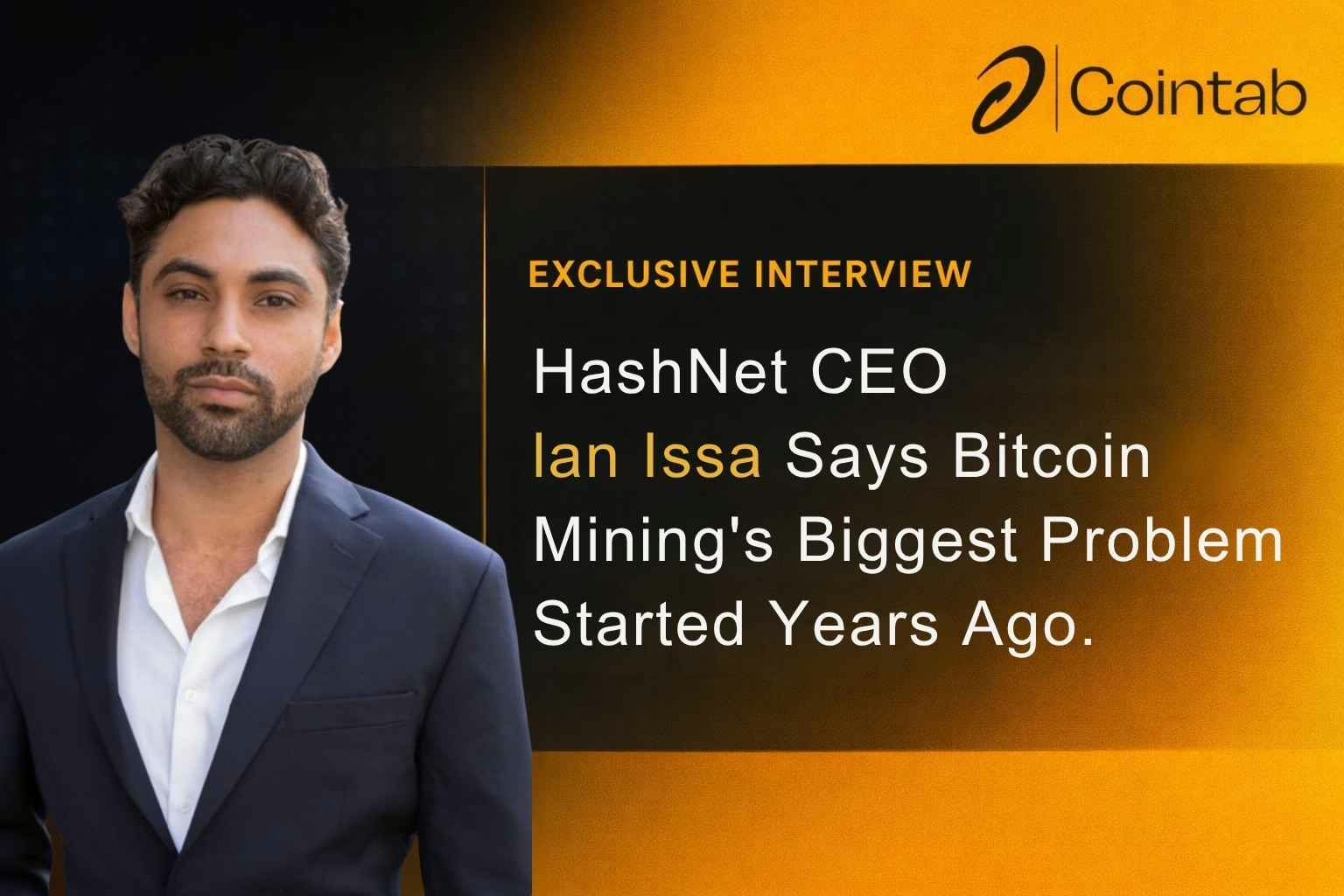
In a wide-ranging interview with CoinTab, the HashNet founder discussed in detail why he believed the traditional Bitcoin mining model had already started breaking down in 2022.
In his early days, Issa was a former Division I athlete whose career ended in injury, and later became a two-time founder with private equity exits before building at the intersection of AI and digital asset infrastructure long before DeFi entered the mainstream conversation. His experience across technology, finance, and infrastructure has shaped a reputation for taking positions early and speaking plainly about market realities.
While companies like Core Scientific, Riot Platforms, and MARA Holdings kept expanding their Bitcoin operations at the time, Issa said he saw a business trapped by rising costs, growing debt, and shrinking rewards.
Moreover, instead of betting everything on Bitcoin alone, HashNet built a multi-currency mining system designed to shift across different algorithms depending on market conditions. Four years later, Issa says the industry’s current move into AI infrastructure only proves his point.
“I Looked at the Same Data and Saw a Countdown”
Issa said the biggest mistake many mining companies made was assuming Bitcoin’s price would always outrun operational costs.
“They built their entire business on a single bet. That Bitcoin’s price would outrun their costs forever. I looked at the same data and saw a countdown,” he said.
According to him, the warning signs were already obvious by 2022. He pinpointed three reasons for this. First, the 2024 Bitcoin halving, which slashes the block reward every four years, was approaching. Next, the mining difficulty continued climbing, meaning that miners were plugging in more hardware to boost their mining capacity. The HashNet founder then mentioned that many firms carried large amounts of debt tied directly to BTC’s price.
Furthermore, while many operators focused on mining more Bitcoin more efficiently, Issa says he came to a different conclusion. He believed mining companies needed to stop relying on Bitcoin’s economics alone.
He pointed to Core Scientific’s bankruptcy filing in late 2022 as proof that the pressure had already started building long before the halving arrived, before the firm’s eventual acquisition.
“The model was already broken before the catalyst arrived,” he said.
Additionally, Issa also argued that the industry’s current shift toward AI data centers shows how dramatically the market changed in just a few years. He referenced Core Scientific’s infrastructure deal with Microsoft as one example of mining firms moving away from the exact strategy they once doubled down on.
How HashNet Avoided the Liquidity Trap
One of the biggest claims HashNet makes is that it has gone four years without missing payouts, even through the 2022 market crash and the 2024 halving cycle.
Issa says that stability came from building a system that never depended on one coin alone.
“The companies that got squeezed had one revenue stream and a cost base that didn’t move when Bitcoin did,” he said.
According to him, many mining firms responded to falling Bitcoin prices by raising more capital or selling reserves because they had no other way to protect margins.
HashNet instead spread operations across different currencies and algorithms. The company continuously converted earnings into Bitcoin instead of holding through market downturns and waiting for prices to recover.
“Our multi-currency model means we’re never dependent on one coin’s economics. The diversification is built into the infrastructure, not layered on top through financial instruments,” he states.
He described the company’s payout record as proof that the system could survive difficult market conditions before favorable conditions arrived.
“The model was designed to hold, It held.”
Even as more mining companies pivot toward AI infrastructure, Issa does not believe Bitcoin mining will disappear. He believes the industry will simply look very different in the years ahead.
“It won’t disappear, It’ll evolve, and most of today’s operators won’t survive that evolution.”
Moreover, he described the old model of mining one coin and hoping prices continue rising as increasingly unsustainable. In its place, he sees multi-currency infrastructure becoming more important as miners search for flexibility.
Issa pointed to the recent Zcash rally as an example. Operators already mining the asset benefited immediately, while single-coin Bitcoin miners could not react fast enough.
“Mining evolves or operators get left behind,” he said.
Why Africa Matters in the Future of Digital Infrastructure
Unlike most Western companies choosing locations in the U.S. and Europe to build their mining infrastructure, HashNet opted for Ethiopia.
Why go to Africa? He explained that Ethiopia’s hydroelectric energy supply will bring a major long-term advantage to his company. Recall that electricity tariffs are one of the biggest challenges miners face in most regions.
Issa stated that more companies may eventually move into these once-ignored regions, such as Africa. This could happen, especially because neither Bitcoin mining nor AI data centers can do without electricity. In fact, he believes the global race for cheap and reliable energy will become even more competitive as AI companies and mining firms chase the same resources.
“That pressure pushes infrastructure toward wherever energy is cheapest and cleanest, a lot of that is outside the U.S.”
Notably, the strongest moment in the interview came when Issa addressed what he believes many mining executives privately understand but refuse to say publicly.
“That solely mining Bitcoin is a dying model, Most of the industry knows it but can’t say it out loud because their whole business depends on pretending otherwise, he states.
For Issa, the future belongs to mining companies that prepare for changing conditions before those conditions force them to change. After four years of building quietly, he says HashNet positioned itself on the right side of that shift long before the rest of the industry noticed it.





 Wilfred Michael | March 26, 2026
 Michelle Abigail | March 22, 2026